You don’t have to show up in person for everything. You just need the right letter, called an authorization letter. An authorization letter lets someone you trust go in your place. Whether you’re out of town, too busy, or unwell, a signed authorization letter is usually all you need to give the person representing you authority.
In this article, you’ll learn what an authorization letter is, when you need one, what to include in it, and how to write one correctly.
Key Takeaways
- An authorization letter is a written document that gives someone permission to act on your behalf for a specific task, such as collecting documents or certificates.
- Include essential details in your authorization letter, such as the full names of both you and the representative, the specific task, the date, the validity period, contact information, and your signature.
- Follow the receiving organization’s requirements before submitting your letter, as some organizations may require a specific template, supporting identification documents, or notarization.
- Keep your authorization specific and time-limited to prevent misuse, and consider a Power of Attorney for more complex legal, financial, or medical matters.
What Is an Authorization Letter?
An authorization letter is a legal written document that allows a trusted person to act, collect items, submit documents, or handle a specific task on your behalf when you cannot be there in person. The authorizer(you) writes an authorization letter that allows the authorized person(your representative) to act on your behalf to complete a task. These are the parties involved:
- Authorizer – the person giving permission
- Authorized person/representative – the person receiving permission
- Receiving organisation – the office or institution expected to accept the authorization
Reasons for an Authorization Letter
You write an authorization letter to give someone you trust permission to act on your behalf. Below are the most common situations where an authorization letter is required:
- Collecting academic documents: Picking up university transcripts, diplomas, or certificates on behalf of a student.
- Claiming travel documents: Passport collection at an embassy or picking up processed visas from an application center.
- Picking up banking items: Collecting newly issued credit cards, checkbooks, or bank statements.
- Retrieving vital records: Accessing official birth, marriage, or death certificates from government offices.
- Managing medical needs: Picking up prescription medications or requesting copies of medical histories for a relative.
- Authorizing minor travel: Granting permission for a child to travel internationally with one parent, relatives, or a school group.
- Notarization/ Authentication/ legalization: You can write an authorization letter granting another person the right to notarize, authenticate, and legalize your documents on your behalf.
Important: Before sitting down to write your letter, always contact the receiving organization first. Ask them if they accept standard authorization letters, or if they have an internal template you must use instead.
What to Include in an Authorization Letter
When writing an authorization letter, it must include specific details; if any are missing, your representative may be unable to complete the task you assigned. These details include:
- Date and duration: An authorization letter must contain the date it was written and signed and the period of time when the letter remains valid for the receiving organization to confirm the letter is valid and to prevent the authorized person from using the letter anyhow.
- Full Name of the Authorizer: The authorization letter should contain your full name arranged and spelled exactly as it is written on your official Government-Issued ID
- Full Name of the Authorized Person: The authorization letter should also contain the full name of the authorized representative arranged and spelled exactly as it is written on his/ her official Government-Issued ID.
- Specific Task or Responsibility: The power and duty of your representative should also be stated clearly on the authorization letter. Don’t just say pick up documents; specify the exact documents he/she will be picking up.
- Signature: This should be a handwritten signature, as some organizations, like financial institutions, don’t accept digital signatures
- Contact Information: Include your email address and phone number, as well as those of the authorized person, in case the receiving organisation needs to contact either one of you.
- Government-Issued ID: Both you and the authorized person may be asked to provide a photocopy of a valid ID, such as a national ID card, international passport, or driver’s license, so the receiving organization can confirm who is involved.
- Application or Reference Number: Include the number that identifies the document or request, as this helps the organization find it quickly. For example, a WASSCE result can be located easily with your examination number.
How to Write an Authorization Letter: A Step-by-Step Guide
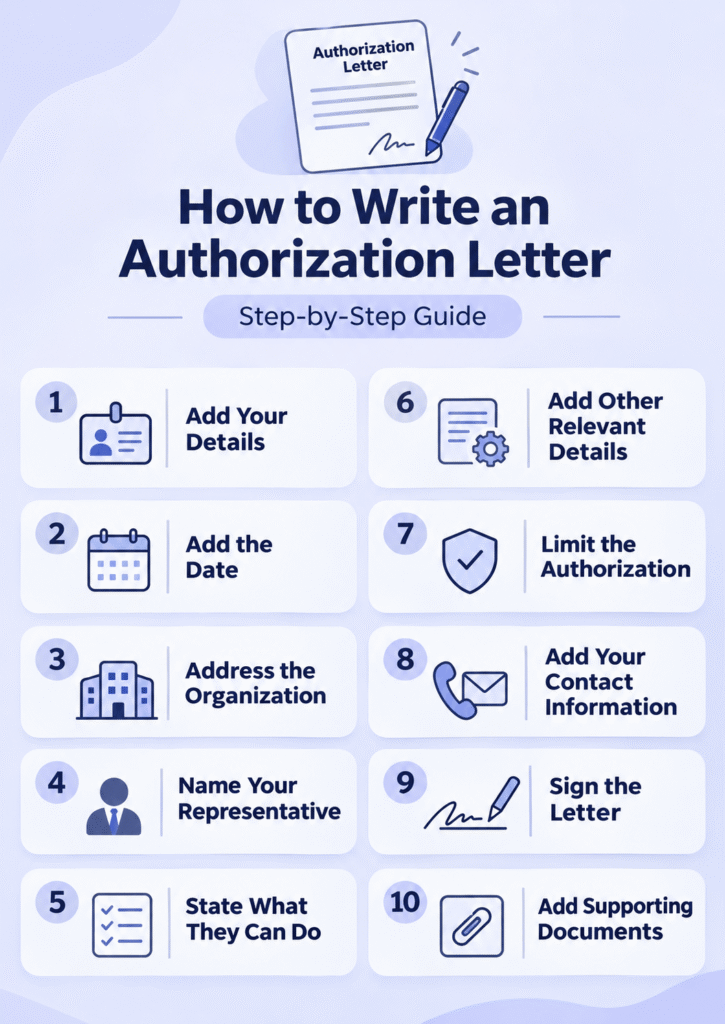
Writing an authorization letter can feel hard without clear guidance, but if you follow the steps below, the office or organization will accept it without any problems. Here is exactly how to draft your letter, step by step :
- Step 1: Add your details: Put your full legal name as it’s written on your Government-issued ID, home address, and contact info at the very top left of the page.
- Step 2: Add the date: Skip a line and write the current date in a formal format (e.g., October 9, 2026) to establish an official timeline.
- Step 3: Address the organization: Skip another line and input the recipient’s details. If you know the specific name of the person handling your request, write it down alongside their department. Otherwise, address it to the organization itself, including their official business address.
- Step 4: Name your representative: State your representative’s full legal name exactly as it appears on the government ID they will show at the counter.
- Step 5: State what they can do: Be very specific about the task. Write “pick up my academic transcript” instead of a vague phrase like “handle my business.”
- Step 6: Add other relevant details: Include helpful identifiers like your bank account number or your student ID.
- Step 7: Limit the authorization: Set boundaries. State if this is for a single transaction only or give it a strict expiration date so it cannot be reused.
- Step 8: Add your contact information: Leave a phone number or email address, telling the clerk to call you directly if they need to double-check anything.
- Step 9: Sign the letter: Close with “Sincerely,” type your name, and sign it by hand. Many traditional institutions reject digital signatures.
- Step 10: Add supporting documents if required: Tell your representative to bring along this signed letter, a copy of your ID, and their own valid photo ID to complete the authorization process.
Need help with your documents? Talk to a Document Agency today.
Authorization Letter Sample
Authorization Letter for Legalization of Documents Sample
[Your Full Name]
[Your Home Address]
[Phone Number] | [Email Address]
November 12, 2026
The Legalization Officer
[Name of Ministry/Embassy/Office]
[Office Address]
Subject: Authorization to Submit and Collect Documents for Legalization
Dear Sir/Madam,
I, [Your Full Name], authorize [Representative’s Full Name], whose valid [ID type] number is [ID Number], to submit and collect the following documents for legalization on my behalf:
- [Birth certificate, Reference No. (if any)]
- [Degree certificate]
- [Marriage certificate]
My representative is authorized to submit the documents, pay the required fees, and collect the legalized copies. He/she is not authorized to do anything else on my behalf.
This authorization is valid from [Start Date] to [End Date]. A photocopy of my [ID type] is attached, and my representative will present his/her own valid photo ID.
Please contact me at [Phone Number] or [Email Address] if you need further confirmation.
Yours faithfully,
[Handwritten Signature]
[Your Typed Full Name]
Authorization Letter for Authentication of Documents
[Your Full Name]
[Your Home Address]
[Phone Number] | [Email Address]
November 12, 2026
The Authentication Officer
[Name of Authenticating Body]
[Office Address]
Subject: Authorization to Process Authentication of My Documents
Dear Sir/Madam,
I, [Your Full Name], authorize [Representative’s Full Name], whose valid [ID type] number is [ID Number], to submit my [name of document, e.g. WASSCE result, Examination No. (number)] for authentication and to collect the authenticated copy on my behalf.
This authorization covers this single request only and remains valid until [Expiry Date], after which it should be considered void.
A copy of my valid ID is attached for your records. You can reach me at [Phone Number] or [Email Address] to verify this authorization.
Sincerely,
[Handwritten Signature]
[Your Typed Full Name]
Important Tips: Print each letter, sign it by hand, and have your representative carry the original along with a copy of your ID and their own photo ID. If the organisation has its own form, use that instead.
Authorization Letter vs Power of Attorney
An authorization letter is just a lightweight, short-term permission slip that gives someone you trust authority to act on your behalf while running simple low risk errands but in some situations that involve high stakes scenarios where significant financial, medical, or legal consequences are involved you must use a Power of Attorney. You will strictly need a Power of Attorney for major life events like:
- Real Estate Transactions
- Managing investment portfolios
- Filing taxes
- Major healthcare decisions
- Signing binding contracts
- handling lawsuits
Common Authorization Letter Mistakes to Avoid
A single error can lead to an immediate rejection. Avoid these common mistakes when drafting your letter:
- Using vague language: Avoid broad phrases like “handling my business”; state the exact task clearly.
- Wrong name on the letter: Write your representative’s full legal name exactly as it appears on their government ID, or they will be turned away.
- Forgetting the duration: Never leave it open-ended; specify a clear deadline for which the letter is valid.
- Omitting your contact info: Always include an active phone number so the organization can call to verify details.
- Using a digital signature: Many traditional institutions strictly reject digital signatures and require a physical ink signature.
- Ignoring the organization’s policy: Sending a generic letter when the institution requires its own format or a notary.
- Leaving out reference numbers: Forgetting to include vital tracking codes like a passport application number, account numbers, student IDs, or invoice numbers.
- Forgetting supporting documents: Sending your representative without a photocopy of your ID and their own physical ID.
Frequently Asked Questions
You can write an authorization letter yourself, or download a template online and customize it to your needs.
Yes, you can use an authorization letter to authorize someone to collect documents on your behalf, provided the issuing organization accepts it.
No, not usually, but notarization may be required depending on the purpose and the organization’s requirements.
An authorization letter is valid for the period stated in the letter or until the specified task is completed, unless it is revoked earlier.
Conclusion
An authorization letter lets someone you trust handle a task for you when you can’t be there in person. It should include the right details, such as full names, the exact task, the validity period, your signature, and valid IDs. Remember to keep the authorization specific and time-limited to prevent misuse.
Need help getting your documents ready or properly processed? Reach out to a document agency today that can help guide you every step of the way.
Get your documents processed without the stress.