Legalization of documents in Nigeria is an important step you must complete before any foreign authority will accept your documents.
Many Nigerians have had their documents rejected abroad, not because they are fake, but because they were never properly legalized by that country’s embassy in Nigeria.
In this article, you will learn what document legalization is, why it is important, and how it differs from an apostille and notarization.
Key takeaways
- Legalization confirms a document can be officially accepted abroad, not just that it’s genuine.
- Nigeria isn’t part of the Hague Apostille Convention, so all Nigerian documents require full legalization, not an apostille.
- The process follows a set order: notarization, ministry authentication, Ministry of Foreign Affairs, embassy legalization.
- Only the destination embassy can legalize a document; agents can only assist with the process.
What Is Legalization of Documents?
Legalization of documents is the official process of getting a foreign country’s embassy to certify that your document is genuine and that it should be accepted in that country.
This is the last stage of adding an official stamp of trust to a document. Legalization of documents is done by the embassy or consulate of the foreign country you intend to use the document in.
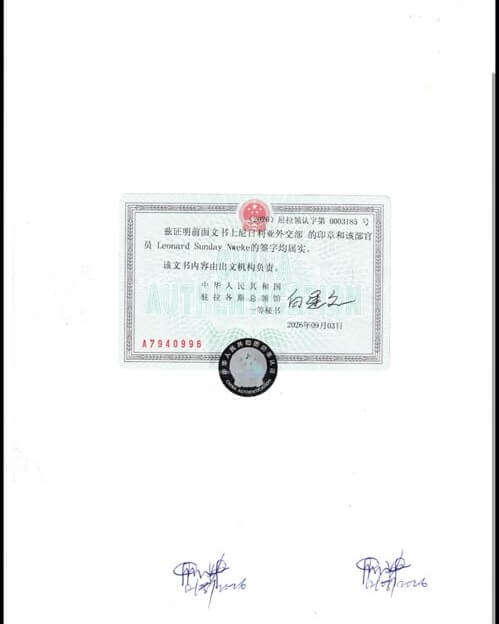
Legalization example
Why Do Nigerian Documents Need to Be Legalized?
Legalization is required because a document valid in Nigeria has no automatic legal standing outside Nigeria. Universities, foreign governments, immigration, employers, family unification, businesses, and other institutions have no way to independently verify a Nigerian document, signature, seal, or stamp, but with legalization, they can trust that the document is real and can be accepted for official purposes.
Which Documents Can Be Legalized in Nigeria?
Here are some documents that can be legalized and the reason for their legalization:
|
Documents that can be legalized |
Common reason for legalization |
|
Birth certificate |
Immigration/family application |
|
Marriage certificate |
Marriage/family/immigration |
|
Education certificate |
Study/employment |
|
Police character certificate |
Immigration/employment |
|
Medical report |
Immigration/visa applications |
|
Affidavit |
Legal/administrative purposes |
|
Power of attorney |
Overseas legal/business matters |
|
Cooperate document |
International business |
How to legalize a document in Nigeria
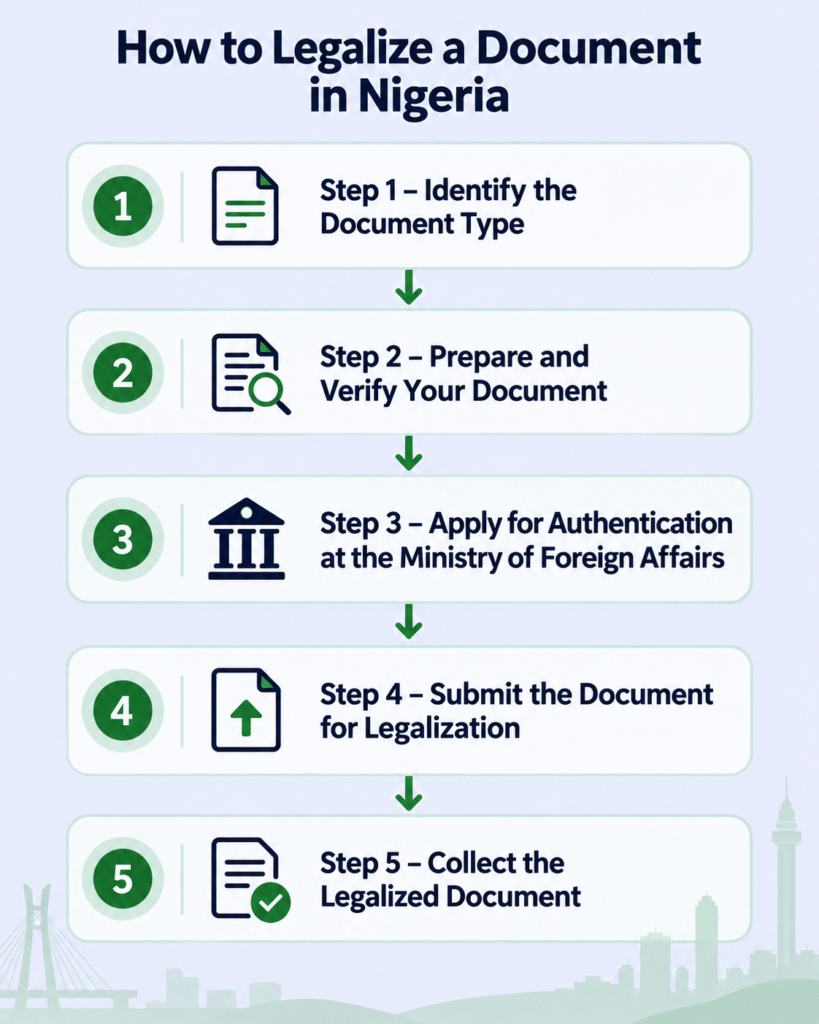
The legalization process generally follows this path: notarization, relevant ministry authentication, Ministry of Foreign Affairs authentication, and embassy legalization. Here is a step-by-step breakdown of the legalization process:
Step 1 – Identify the document type
Confirm which document you need to legalize based on the purpose of your legalization and the requirements of the foreign country.
Step 2- Prepare and verify your document
Make sure your document is original and properly certified. Depending on the document, you may need to verify it with the issuing authority, such as the National Population Commission for birth certificates, or have it notarized by a Nigerian Notary Public before authentication.
Step 3 – Apply for authentication at the Ministry of Foreign Affairs
The Nigerian Ministry of Foreign Affairs handles the authentication of Nigerian documents for international use. All your documents must be authenticated by the Ministry of Foreign Affairs before they can be accepted for legalization.
Step 4 – Submit the document for legalization
After authentication, the document is ready for the legalization stage. Before submitting, confirm whether you should use your embassy, consulate, or another country’s embassy for the submission of the document for legalization.
Step 5 – Collect the legalized document
Once processing is complete, you will be contacted to collect your legalized document with the final legalization stamp or seal for your destination country on it.
Let us guide you through the legalization process in Nigeria.
How Much Is Legalization of Documents in Nigeria?
There’s no single fixed price for legalizing a document in Nigeria; the total cost builds up across several stages and can range from a few thousand naira for a simple one-page document to several hundred thousand naira for multi-page documents. Here is a breakdown of what the cost entails:
- Authentication/certification fees
- Nigerian Ministry of Foreign Affairs fees
- Destination country embassy/consular fees
- Service/agency fees
Where Can I Legalize a Document in Nigeria?
Legalization of documents takes place at your destination country’s embassy or consulate in Nigeria. Some countries that do not have an embassy in Nigeria usually employ a third-party service like TLS or VFS for the submission of documents for legalization, or use their nearest embassy that is officially accredited to handle Nigeria, often located in a neighboring country, either by courier or in person.
Legalization and Authentication: What’s the Difference?
Here are the major differences between authentication and legalization:
|
Authentication |
Legalization |
|
|
Who performs it |
The issuing institution and the Ministry of Foreign Affairs. |
The destination country’s embassy or consulate. |
|
When it happens |
An earlier step in the process of verifying documents. |
Later in the process or a final step in verifying documents. |
|
Depends on |
The original document and its signature or seal. |
A prior, valid authentication. |
|
Scope |
Confirms the document is genuine. |
Confirms that the document is acceptable for use in a specific country. |
Which Countries Require Legalization of Documents?
Countries that are part of the Hague Apostille Convention do not require legalization from other member countries. But since Nigeria is NOT a member, you must always legalize your Nigerian document even if your destination country is a member of the Hague Apostille Convention.
This simply means that every country requires you to legalize your Nigerian document at their embassy or consulate before it will be acceptable for use in their country.
How Long Does Legalization of Documents Take?
There is no fixed time for how long it takes to legalize a document; the total time depends on several factors, such as the document type, the number of documents to be legalized, authentication requirements, the country’s embassy, and other considerations. But it usually takes between 3 and 15 days.
Who Can Legalize Documents?
After submission of your documents, the officials at your destination country’s embassy or consulate are responsible for stamping and sealing your documents as part of the official legalization process. You can also use a visa processing agent to assist you with legalizing your documents.
Do I Need an Appointment for Document Legalization?
Yes, most embassies require you to book an appointment to submit documents for legalization; you cannot just walk into the embassy for legalization. Start by going to your destination country’s official site for legalization appointment booking and get an available slot.
Common Mistakes to Avoid When Legalizing Documents in Nigeria
- Legalizing the wrong document: The receiving authority may require a specific version of a document, an original transcript rather than a statement of results, for example, or a particular certificate format.
- Skipping authentication when it’s required: Some documents need prior verification, like Ministry of Education authentication for academic documents and the Ministry of Foreign Affairs authentication before they can be legalized.
- Assuming every country has the same process: Legalization requirements vary considerably by destination country.
- Checking requirements too late: Because legalization can involve several stages like notarization, ministry authentication, and embassy legalization, leaving requirement checks until the last minute often leads to delays.
- Errors in personal details: Names, dates of birth, and other personal information must match exactly across the document, your passport, and all related paperwork. Even a small misspelled name or an incorrect date can lead to rejection.
- Not booking an appointment: You must first book an appointment with the embassy or consulate before you can show up for legalization.
Frequently asked questions
No. Authentication confirms a signature, seal, or stamp on a document is genuine. Legalization confirms the document is officially accepted for use in a specific foreign country.
No. An apostille is a simplified, single-step certification used between countries that are part of the Hague Apostille Convention. Nigeria is not a member, so Nigerian documents cannot be apostilled; they require full authentication and legalization instead.
Yes, a representative or agency can submit and process your documents on your behalf, often with an authorization letter.
Conclusion
Legalizing a document is an act of building trust across borders. A Nigerian birth certificate, degree, or power of attorney carries full weight at home, but the moment it needs to mean something to a foreign university, embassy, or employer, that trust has to be earned again through legalization.
If you are looking to legalize your documents, start early, since each stage can take time; confirm requirements directly with the relevant authority rather than relying on assumptions, or contact an agent to assist you.
Get expert support with embassy legalization.