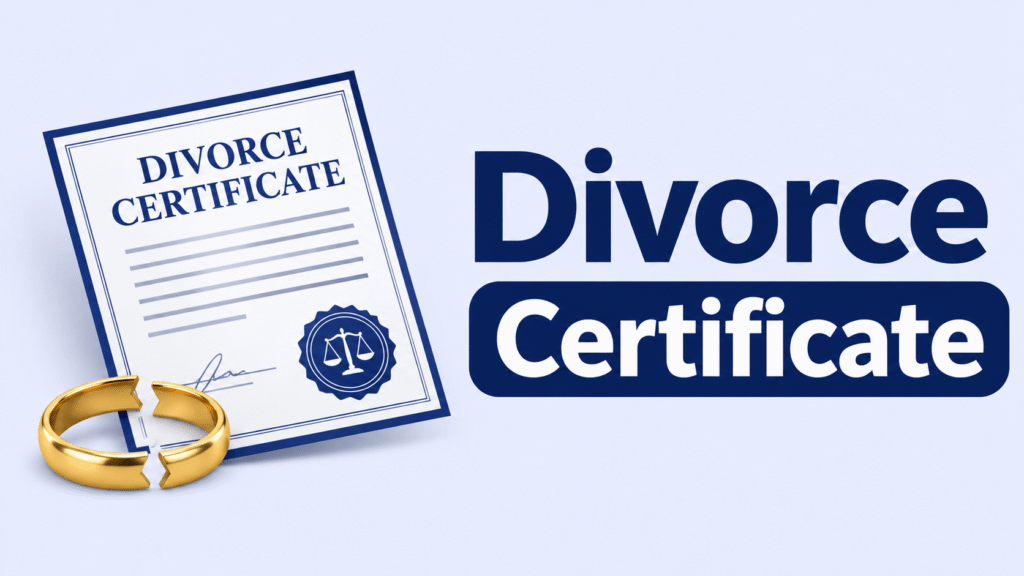
If you are holding your first divorce papers in Nigeria and calling them a divorce certificate, you may be celebrating too soon, because for a statutory marriage, that paper is usually the decree nisi, which is only a temporary court order and not final proof that your marriage has ended.
The real certificate is the decree absolute. You get it after a waiting period of three months, and it is the one courts, banks, and immigration officers will accept. Most people confuse the two, and this can lead to loss of time, money, and even visa rejection.
This guide will show you how to tell them apart, how to get one, how to verify it, and how to replace a missing copy.
Key Takeaways
- A decree nisi is not your final divorce proof; only the decree absolute, with its Certified True Copy, shows your marriage has truly ended.
- You must first meet a lawyer, file a petition in the High Court, and wait for the decree nisi to become absolute after at least 3 months.
- Budget at least ₦800,000 and plan to wait for at least 12 to 24 months, though the cost and time depend on your case.
- If you lose your divorce papers, you are still divorced, and you can apply for a new Certified True Copy from the court registry.
What Is a Divorce Certificate?
A divorce certificate, also called the Certificate of Decree Absolute, is the official document that proves a marriage has fully ended according to the law. In Nigeria, the court may not give you a paper called a divorce certificate; instead, you get a certificate showing that the first court order has become final.
Under Section 59(2) of the Matrimonial Causes Act, once a decree nisi has become absolute, any person can apply to the registrar of the court that made the decree and, on paying the appropriate fee, receive a certificate signed by the registrar. That certificate is evidence in all courts and for all purposes that the decree has become absolute.
Stages of a Divorce
- Divorce Petition: This is the form one spouse files in court to start the divorce. Filing it does not end the marriage. It only asks the court to look into the matter.
- Decree Nisi: After hearing the case, the court may give this temporary order (Section 56). It means the court agrees the marriage has broken down and a divorce can be granted. But you are still married, and it is against the law to marry again at this stage. You must wait for some time, in case anyone wants to object or appeal.
- Decree Absolute: This is the final order that ends the marriage for good. It comes only after the waiting time has passed and all conditions, like arrangements for the children, are settled. It is strong proof that the marriage is over, and both of you can marry again.
- Certified True Copy: This is a copy of a court document, like the Decree Absolute, that the court registry has stamped and signed to confirm it is exactly the same as the original.
Source: Matrimonial Causes Act
What Does a Nigerian Divorce Certificate Look Like?
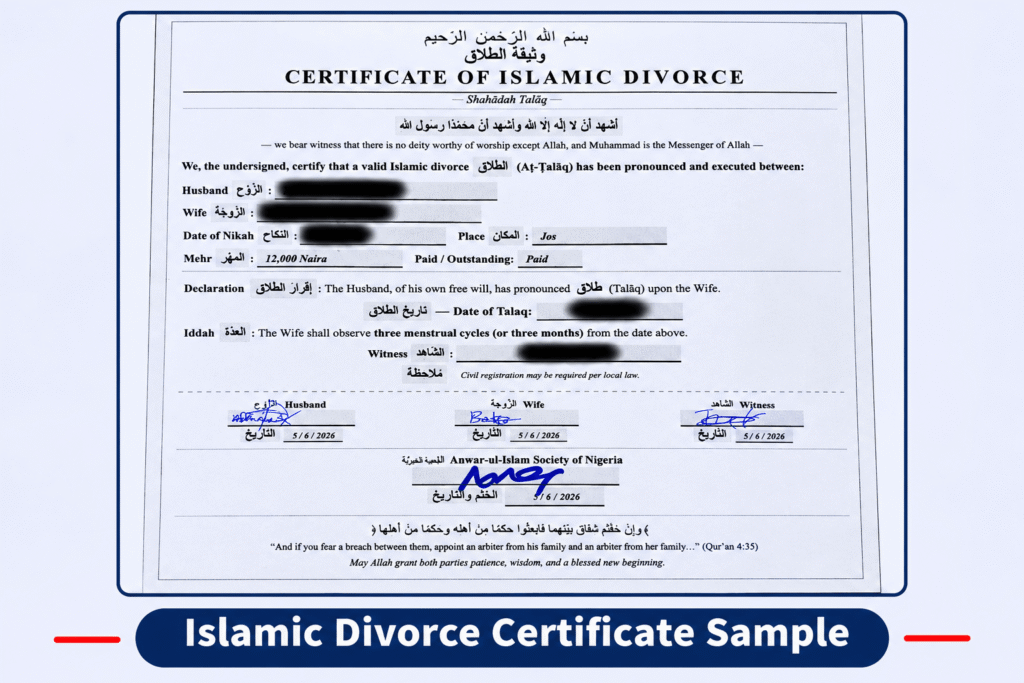
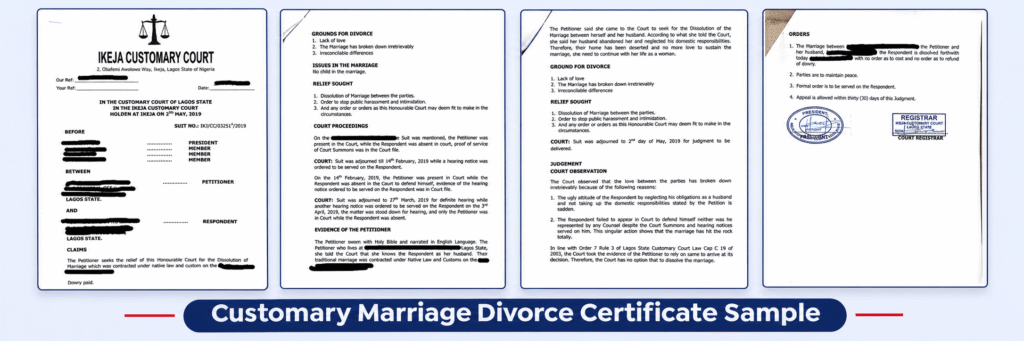
Who Issues a Divorce Certificate in Nigeria?
The court that handles your Divorce proceedings is the one that issues your divorce certificate, depending on the kind of legal marriage you want to dissolve. In Nigeria they are three legally recognised marriage certificates, and the table below shows the court responsible for each;
|
Marriage Type |
Issuing |
Official Document Issued |
|
Statutory Marriage (Registry / Church Weddings) |
High Court of a State (or the FCT High Court) |
Decree Absolute |
|
Customary Marriage (Traditional Weddings) |
Customary Court (of the relevant Local Government Area) |
Customary Court Judgment/Order of Dissolution |
|
Islamic Marriage (Nikkah) |
Sharia Court (or Area Court in non-Sharia states) |
Sharia Court Divorce Certificate |
NOTE: The Matrimonial Causes Act applies only to statutory marriages, not to customary or Islamic marriages.
How to Get a Divorce Certificate in Nigeria
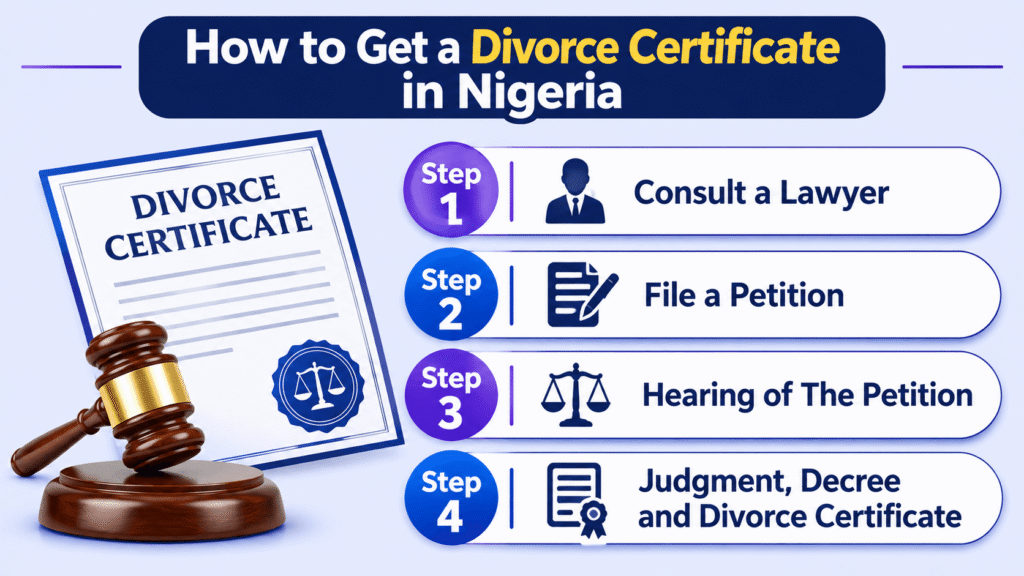
Getting a divorce in Nigeria is not as easy as getting married, as the Nigerian courts treat divorce very delicately. Before your marriage can be dissolved, you must prove to the court that your marriage has been damaged beyond reconciliation. The following processes provide a clear path on how you can obtain a divorce in Nigeria:
- Step1:Consult a Lawyer: The first thing to do when you decide to divorce is to meet a divorce lawyer and explain your case. The lawyer will find the facts that count as grounds for divorce from your reasons. If you have more than one, the lawyer will advise you to use the one with the strongest proof. Nigerian law has at least eight such facts.
- Step2: File a Petition: Your lawyer starts the divorce by filing a petition in the High Court of any state, as it is the only court that can hear it. If the court orders you to support your spouse financially but you refuse to do so, you can be forced to pay the support by a lower court that handles such cases. For divorce cases, your domicile is Nigeria, wherever you live. The petition states who you married, when, your grounds, what you want, and your proof. It gets a file number and is served on your spouse, who must reply on time.
- Step3: Hearing of the Petition: Once your spouse replies to the petition, the court fixes a date to hear the case. How long the hearing takes, and the kind of evidence needed, depends on whether your spouse is fighting the case and what you want from the marriage, like damages, maintenance, child custody, or property. Any witnesses must support the evidence. The court must also consider from time to time whether you and your spouse can reconcile.
- Step4: Judgment, Decree and Divorce Certificate: If you prove your grounds for divorce, the court gives a decree nisi. It does not end the marriage yet, but it shows the court agrees the marriage has broken down for good. Both parties involved can appeal within 3 months, before it becomes absolute. After that, they cannot appeal. Once absolute, you can marry again, and your divorce certificate is issued.The court also decides on damages, maintenance, and child custody, and must be satisfied with the arrangements made for any children under 16.
Start Your Divorce Certificate Processing
How Much Is a Divorce Certificate in Nigeria?
To get a divorce certificate, you should budget at least ₦800,000 for the entire divorce process. Keep in mind that this is a starting point. The amount you actually spend will depend on the circumstances surrounding your marriage, so it varies from person to person.
The cost of a divorce certificate in Nigeria depends on several factors, which include:
- Children: whether the marriage produced children, and whether they are above or below 16 years of age.
- Length of the marriage: how long the marriage lasted before the divorce.
- Your lawyer: the experience level of the lawyer handling your case.
- Your spouse’s response: whether your spouse contests the divorce petition.
- Location: the state high court where you file, since costs vary from state to state.
- Court filing fees: You will be required to pay a fee directly to the court registry to open a legal case and process your documents.
- Decree absolute & certified true copy: Obtaining your certified true copies or the decree absolute from the High Court registry costs money.
How Long Does It Take to Get a Divorce Certificate?
In Nigeria, the period of time it takes to get your final divorce certificate depends on the type of marriage you are divorcing and the court proceeding you go through. For a statutory marriage, the timeline is split into three different phases :
- Time Spent Obtaining the Divorce: From the day your lawyer files the divorce petition to the day the judge grants the divorce, it usually takes 12 to 24 months. How long yours takes depends on how crowded the court is, how well the court keeps to its dates, and whether your spouse fights the case. If your spouse contests it, it can take two years or more. If not, it may take 9 to 12 months.
- Time Before the Decree Becomes Absolute: After the judge decides to end your marriage, you cannot get the final divorce paper immediately. Section 56 of the Matrimonial Causes Act says you must first get a decree nisi. If you have no children under 16, it becomes final after 3 months. If you do, the court must first confirm the children’s care is settled, and it becomes final 28 days after that or 3 months, whichever is later. You are still married during this time, so marrying again is void.
- Time the Registry Needs to Prepare or Retrieve the Document: Your decree becomes absolute by itself after three months, but you still need a Certified True Copy of the Decree Absolute as your divorce certificate. For a new divorce, your lawyer applies to the court registry after the three months, and it takes 2 weeks to 2 months. For an old divorce, the registry must find your file in the archives, which takes 1 to 4 weeks, depending on the court.
How to Verify a Nigerian Divorce Certificate
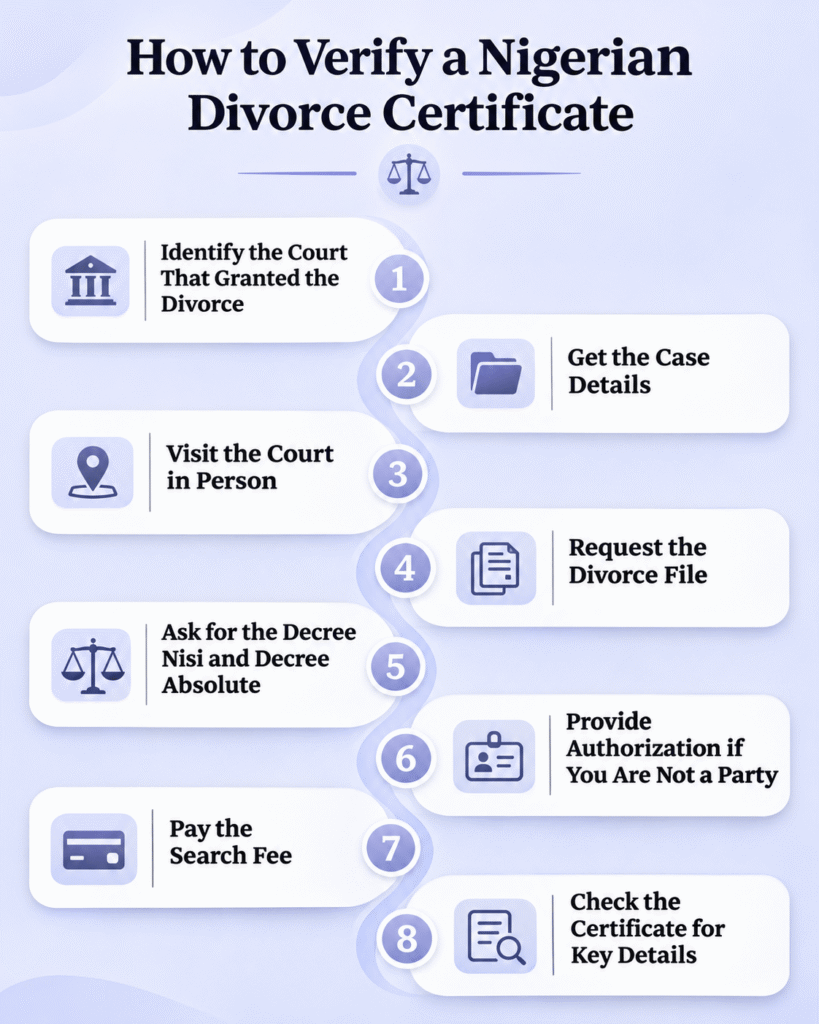
Step 1: Identify the court that granted the divorce
Find out which court issued the divorce. This is the court where the verification must be done.
Step 2: Get the case details
Obtain the case number and the names of both parties. (If you’re not a party to the case, you’ll need to source these details from the document itself or from someone who has them.)
Step 3: Visit the court in person
Go to the same court where the divorce was granted. If you can’t go yourself, send your lawyer.
Step 4: Request the divorce file
At the court registry, ask to see the divorce file for the case.
Step 5: Ask for the decree nisi and decree absolute
Request both documents so you can compare them against the certificate you’re verifying.
Step 6: Provide authorization if you’re not a party to the case
If you’re neither the petitioner nor the respondent, you’ll need either a letter from a lawyer, or written consent from one of the parties
Step 7: Pay the search fee, if required
Some courts charge a fee for searching and accessing the file. Confirm the amount at the registry.
Step 8: Check the certificate for key details. A valid divorce certificate (decree absolute) should show: the court name, the names of both parties, the case number, the judge’s signature, and the court seal.
Note: Nigerian courts don’t currently have an online database for divorce records, so verification has to be done in person or through a lawyer.
What If I Have Lost My Divorce Certificate?
Losing the physical copy of your divorce certificate doesn’t undo the divorce you had, as you
will remain legally divorced even when you can no longer find your decree absolute.
If you have lost your divorce papers, to get a replacement, apply for a certified true copy of your divorce certificate to the registrar of the court that made the decree. Give the court name, your name and your ex-partner’s name, the case number and the date the decree became absolute, and pay the appropriate fee.
Once your identity has been certified and your legal document has been located, you can go and collect the certified true copy from the court.
Is a Divorce Certificate Issued Abroad Recognised in Nigeria?
Whether Nigeria will accept a divorce you got abroad depends mainly on whether the foreign court had the power to end your marriage. Nigerian courts will usually recognize the divorce if, when the case started, you or your spouse was living in the country that granted it.
The case must also have been fair, meaning both of you were properly notified and had a chance to state your case. Finally, the divorce must not have been obtained by fraud.
Frequently Asked Questions
No. A decree nisi is provisional; a decree absolute is the final legal proof that the marriage has been dissolved.
Only your authentic, officially issued document that can be verified is acceptable; a downloaded sample or unofficial PDF is not valid proof.
Divorce papers are documents used or issued during divorce proceedings, while a divorce certificate is an official document confirming that the divorce has been legally finalised.
Conclusion
A decree nisi is not your final proof of divorce. Only the decree absolute, together with its Certified True Copy, shows that your marriage has legally ended. To get there, you must hire a lawyer, file a petition, attend the hearing, and wait for the decree nisi to become absolute. The cost and timeline depend on your case, but you should plan for a significant budget and several months. Until the decree is absolute, you cannot legally marry again.
If you lose your papers along the way, you can still get a replacement from the court registry. But the process can be stressful and time-consuming, especially if you are handling it alone. If you need help with your divorce documents or want a replacement copy, a reliable Document Agency can guide you through each step.
Get Your Divorce Certificate