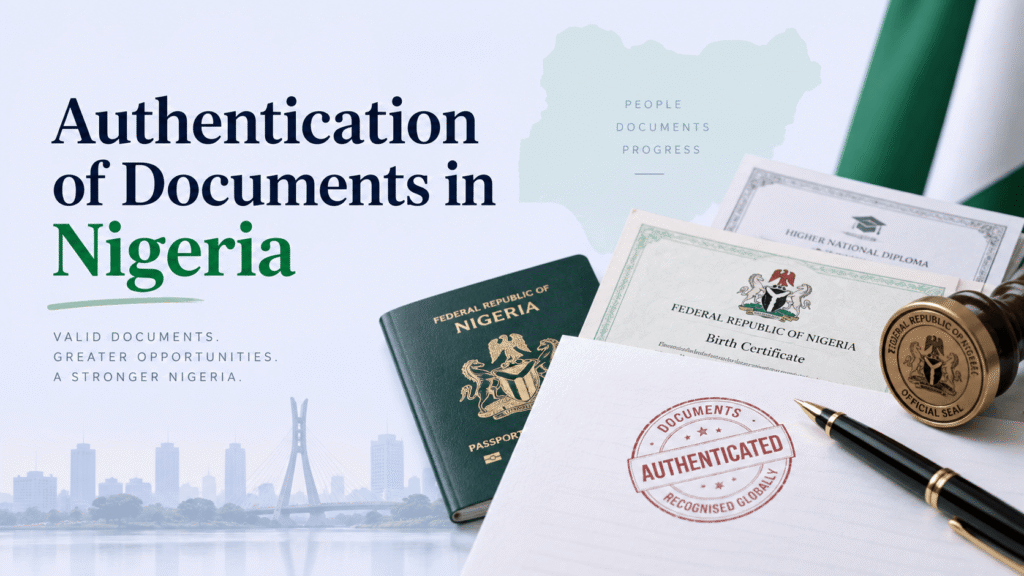
Authentication of documents by the Ministry of Foreign Affairs Nigeria proves that your Nigerian documents are real. Most times embassies, foreign employers, and international schools won’t accept a certificate, degree, or affidavit that has not been authenticated.
Authentication of your Nigerian documents is very important if you want to use them for a visa application, a job abroad, or your school admission abroad. Without it, your application can be rejected.
In this guide, we will help you understand what document authentication is, the process of authentication in Nigeria, the cost of Authentication in Nigeria, and the different forms of authentication in Nigeria.
Key takeaways
- The Ministry of Foreign Affairs is responsible for the authentication of documents in Nigeria.
- Academic documents (degrees, transcripts, WAEC, NECO) must first be verified through the Ministry of Education’s ESS Digital Portal before they can go to the Ministry of Foreign Affairs.
- You will need requirements like your international passport data page, Remita payment receipt, and a completed MFA authentication form to get your documents authenticated.
- Authenticated documents don’t have a fixed government expiry date, but the underlying document or the receiving institution may set its own validity limit.
What is authentication of documents?
Authentication of documents in Nigeria is the process of verifying a document’s authenticity. In Nigeria, document authentication is carried out by the Ministry of Foreign Affairs.
Before your document can be authenticated by the Ministry of Foreign Affairs, it has to be notarized, and if it is an academic document, it must be authenticated by the Ministry of Education before the Ministry of Foreign Affairs will authenticate it.
If you intend to use your document abroad, then you will need to get it legalized after authentication.
What are authenticated documents?
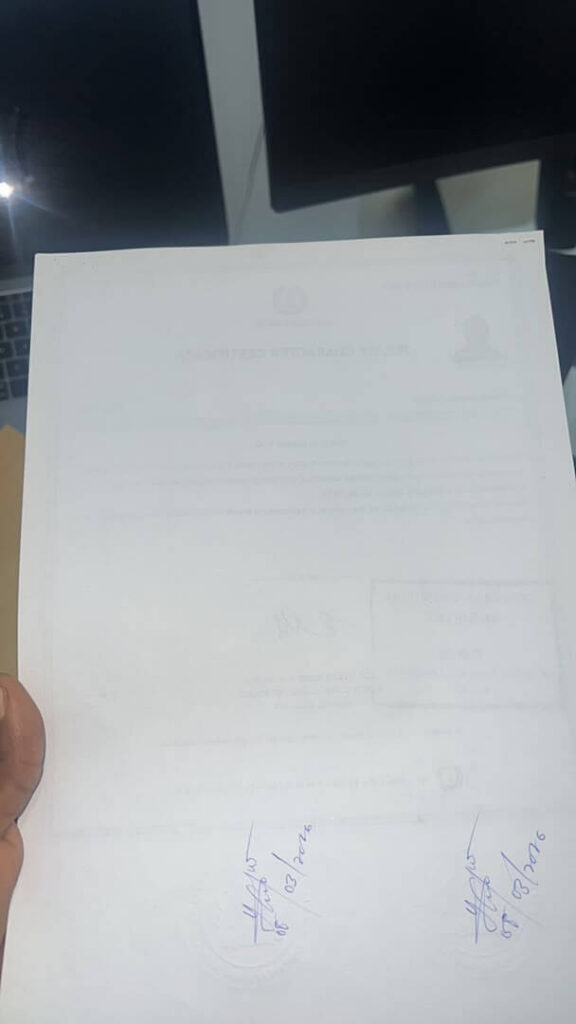
An authenticated document is an official document that has been formally verified and stamped by Nigeria’s Ministry of Foreign Affairs. The MFA is the only authority in Nigeria that can verify Nigerian documents for foreign use.
How to authenticate documents in Nigeria
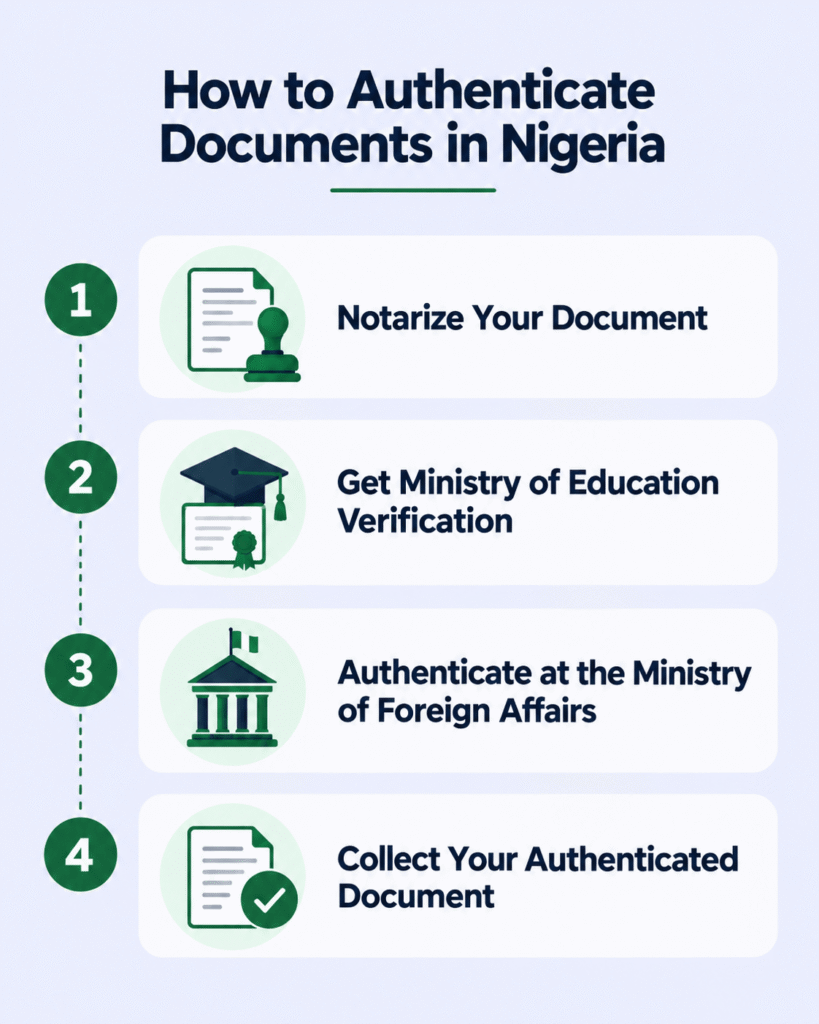
Document authentication in Nigeria follows a clear path. Skip a step, and the Ministry of Foreign Affairs will send your documents back. Here’s how it works, from start to finish.
- Notarize your document: Take your original document to a notary public. The notary public will confirm that it is real and stamp it. This is the first seal your document needs before any other process.
- Get Ministry of Education verification (for academic documents): If you are authenticating a degree, transcript, WAEC certificate, or any other academic document, it must be authenticated by the Ministry of Education. Authentication of academic documents is done fully online through the ESS Digital Portal
- Authenticate at the Ministry of Foreign Affairs: After you have completed the above steps, you can now go to the Ministry of Foreign Affairs in Abuja, fill out the authentication form, and pay the authentication fee through Remita. You will get a Remita Retrieval Reference (RRR) to confirm payment and submit your documents for authentication.
- Collect your authenticated document: When your documents are ready, you will be contacted to pick them up.
Authentication of documents, Ministry of Education Nigeria
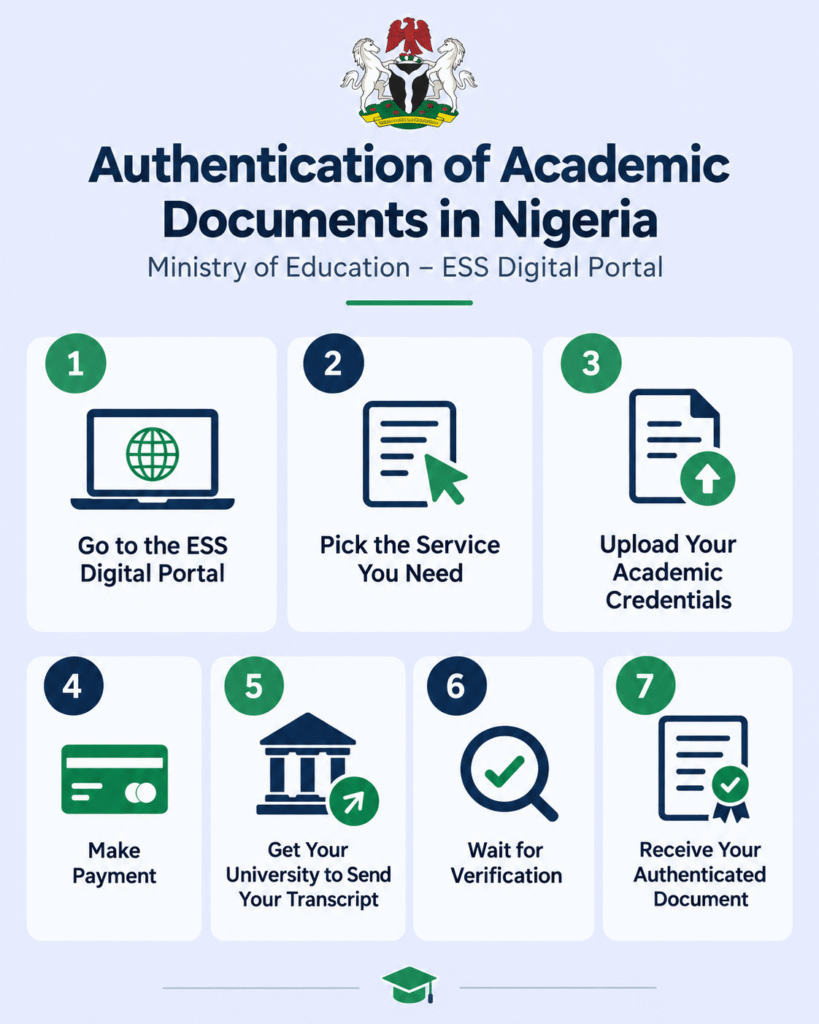
All academic documents must pass through the Ministry of Education before they can move to the next stage, and this process is now done online only. Here is a step-by-step process to guide you:
- Go to the ESS digital portal: Visit https://essverify.education.gov.ng/, which is the official site for academic document verification in Nigeria, and create an account.
- Pick the service you need: Pick authentication of academic documents and provide all your necessary details. Ensure you are uploading correct information.
- Upload your academic credentials: This covers WAEC certificates, NECO results, university and polytechnic degrees, and other types of academic documents. Make sure to upload a good-quality picture of your document.
- Make payment: Authentication is not free; you will be required to pay ₦300 per page through Remita. This payment is non-refundable.
- Get your university to send your transcript: If you are authenticating your transcript, it must be sent directly from your university to the Ministry of Foreign Affairs through this email: ess1@education.gov.ng. You cannot submit your transcript yourself for authentication.
- Wait for verification: The Ministry checks and verifies your documents; you can track the progress of your authentication through the update mails the send.
- Receive your authenticated document: When the process has been completed, you will receive your authenticated academic document in your email.
Source: Federal Ministry of Education
NOTE: Non-academic documents like birth certificates, CAC documents, and marriage certificates skip this step and go straight to the Ministry of Foreign Affairs authentication.
Authentication of Documents: Ministry of Foreign Affairs
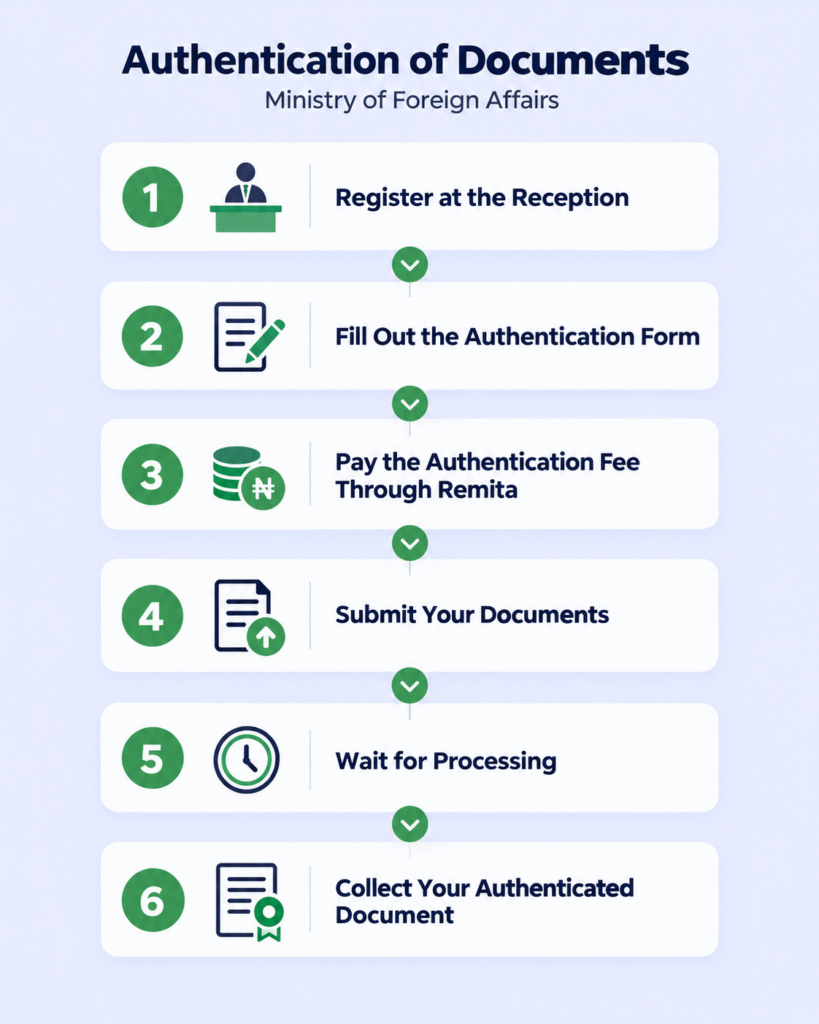
The Ministry of Foreign Affairs (MFA) in Abuja is the only office that authenticates documents for international use. Here is the process:
- Register at the reception: When you arrive at the Ministry of Foreign Affairs, located at Tafawa Balewa House, Central Business District, Abuja, you will be required to register first at the reception.
- Fill out the authentication form: Choose the form that matches your document type and fill it out with your correct details.
- Pay the authentication fee through Remita: Make payment for your MFA authentication through Remita ₦300 per page, and remember to keep your Remita Retrieval Reference (RRR) as proof of payment.
- Submit your documents: Submit all your documents for authentication. Also include your Ministry of Education token if you are authenticating an academic document. You can do this between 8 am and 11 am from Monday to Thursday.
- Wait for processing: Wait for your document to be authenticated.
- Collect your authenticated document: Once stamped, it’s officially recognized for international use. You will be contacted to collect your authenticated documents.
Get expert support with your authentication process.
What are the requirements for authentication of documents
The requirements for document authentication include:
- A copy of the international passport data page
- One photocopy of the document that needs authentication.
- A complete MFA authentication request
- Remita payment receipt
- Appointment slip
- Two Passport
- An Affidavit
- A complete MFA authentication request form
The cost of authentication of documents in Nigeria
The cost of authentication of documents in Nigeria through a verified agent is as follows:
- Birth certificate ₦15,000
- Letter of affidavit ₦15,000
- MOE and MOFA degree ₦50,000
- Police clearance ₦30,000
- Ministry of Health ₦40,000
The official fee for authentication of documents through the Ministry of Education is ₦300 per page.
The official fee for authentication of documents through the Ministry of Foreign Affairs is ₦300 per page.
Frequently asked questions
Authenticated documents do not have an expiry date; however, if the underlying document or the receiving agency has a specified expiry date, then it affects the authenticated document.
A request letter for authentication is a formal letter written to a government authority asking them to officially verify and stamp a document as genuine.
Conclusion
We have discussed document authentication in Nigeria, the steps and requirements necessary. The most important thing to take away from this is to be careful when applying for authentication, read the instructions carefully, and understand them.
Avoid submitting incomplete documents, wrong spelling in names, and skipping a step to get fast results. You can also employ the services of an expert to avoid any stress or mistakes.
Let us guide you through the document authentication process in Nigeria.