If you are planning to study, work, or move abroad, you may need to prove your English skills, and choosing the right test starts with knowing what your destination requires.
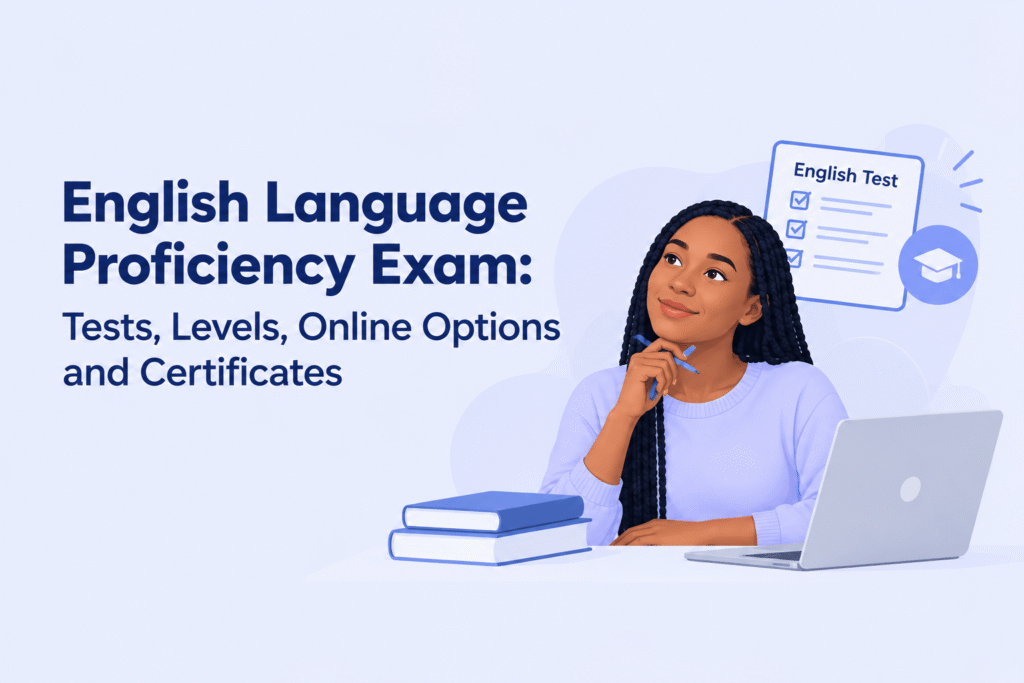
An English language proficiency exam, also called an English language proficiency test, measures how well someone can communicate in English. You may need the test when applying to study at a university, moving to another country, applying for certain jobs, or meeting the requirements of a professional organisation.
An English language proficiency test will assess your skills in reading, writing, listening, and speaking in English. However, different tests have formats, scoring systems, and acceptance rules. Another may not accept a test accepted by one university, employer, or government.
Key Takeaways
- An English proficiency exam measures your ability to use English to read, write, listen, and speak.
- There is no single English proficiency test that is accepted everywhere, so your purpose should guide your choice.
- A free English test can help you practise or estimate your level, but an official English language proficiency test certificate usually requires a recognised paid examination.
- IELTS, TOEFL, PTE Academic, Duolingo English Test, and Cambridge English qualifications are among the major options.
What Is an English Language Proficiency Exam?
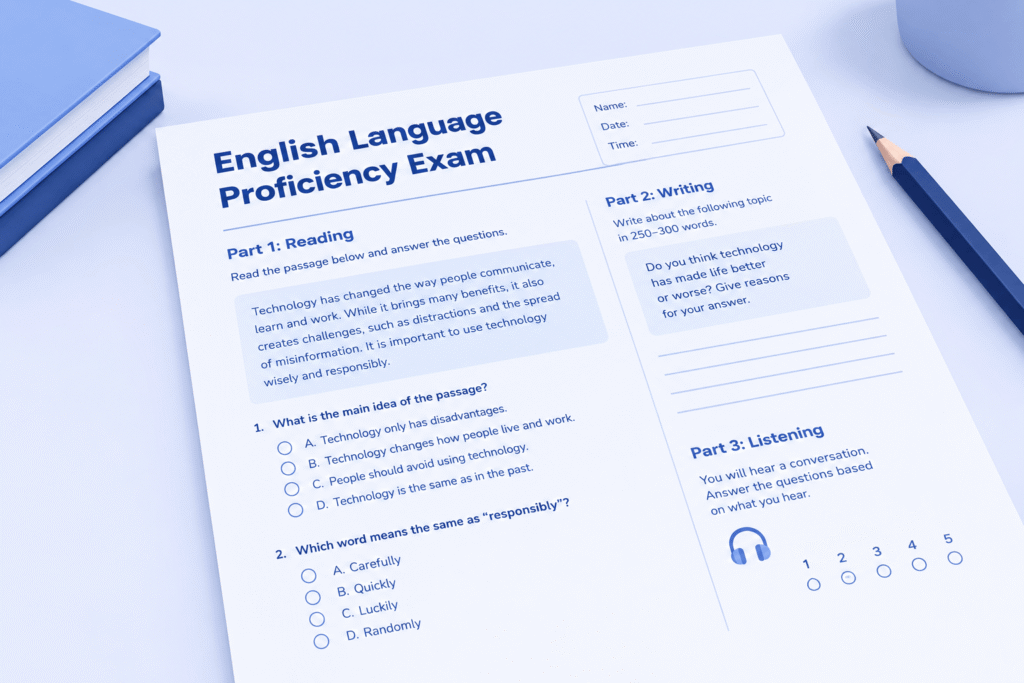
An English language proficiency exam is a standardized assessment used to evaluate how correctly and fluently you can understand, speak, read, and write in English. Rather than just checking memorized grammar rules alone, the test measures your ability to understand academic texts and participate in workplace conversations in English.
Most complete tests evaluate four core modules:
- Reading: Understanding articles, work guides, and written arguments.
- Writing: Writing clear essays, reports, or emails.
- Listening: Following lectures, conversations, and different accents.
- Speaking: Answering questions and sharing ideas clearly.
Why You May Need an English Proficiency Test
You may need an English language proficiency test whenever an institution requires valid proof of your English language skills. Here are some common reasons why you may need one:
- Applying for university or college
- Applying for a visa or immigration programme
- Applying for an international scholarship
- Meeting requirements of a professional body
- Applying for a job that has English language requirements
NOTE: Not every university, employer, or visa programme asks for a test. Always check the requirements of the organisation you are applying to.
Common English Proficiency Exams
The most common English proficiency exams include IELTS, TOEFL iBT, and PTE Academic, the Duolingo English Test, and Cambridge English qualifications.
|
TEST |
BEST KNOWN FOR |
TEST METHOD |
RESULT |
|
Study, migration and professional use |
Test center, IELTS Online available in some countries |
Band score |
|
|
University and academic applications |
Test centers or Home Edition |
1-6 scale with comparable 0-120 score during transition |
|
|
Study, migration and professional use |
Computer-based at test centers |
10-90 |
|
|
University applications |
Online from home |
10-160 |
|
|
Academic and professional English qualifications |
Usually at authorized exam centers |
Cambridge English Scale and grades |
Note: No single test is accepted by every university, employer or government. Always confirm which tests your organisation approves.
English Language Proficiency Levels
The Common European Framework of Reference for Languages (CEFR) provides a useful way to understand English language proficiency levels, although different test results are not directly interchangeable.
The CEFR uses six main levels:
|
CEFR LEVEL |
General Description |
|
A1 |
Beginner |
|
A2 |
Elementary |
|
B1 |
Intermediate |
|
B2 |
Upper- intermediate |
|
C1 |
Advanced |
|
C2 |
Proficient |
The Council of Europe groups these into three broad categories: Basic User, Independent User, and Proficient User.
A1 – BEGINNER
At A1, you can understand and use basic expressions. You can introduce yourself, ask questions, and communicate about familiar topics when communicating with someone.
A2 – Elementary
You can understand common phrases and handle simple, routine tasks.
B1 – Intermediate
At B1, you can understand the main points of familiar topics and deal with many everyday situations.
B2 – Upper-Intermediate
At B2, you can communicate with greater independence and understand more complex ideas and discussions.
C1 – Advanced
At C1, you can understand demanding texts and communicate effectively and flexibly in academic, professional and social situations.
C2 – Proficient
At C2, you can understand almost everything you hear or read and express yourself fluently, precisely and effectively.
The CEFR describes these abilities using can-do statements rather than simply labelling someone as good or bad at English.
Source: Common European Framework of Reference for Languages
How to Prepare for an English Proficiency Test
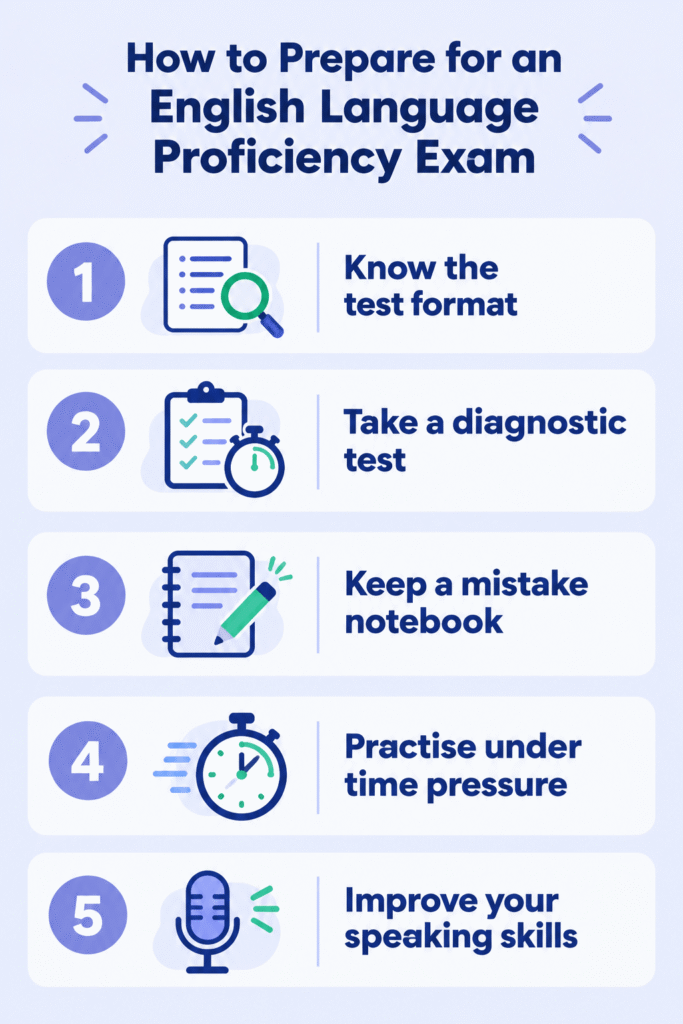
The best way to prepare is to practise the exact format of the test you will take rather than simply studying English in general.
- Find your test question types: Do not use random English exercises; download the official test format and understand what you will actually face.
- Take a diagnostic test: Take a reliable practice test before spending weeks studying; this will help you know your weakest area.
- Keep a mistake notebook: Instead of only recording your score, write down the mistakes you repeatedly make, then work on those weaknesses.
- Practice under time pressure: Knowing English is not enough; you also need to answer questions within the time allowed by the exam.
- Practise speaking aloud: If your exam includes speaking, do not prepare only by reading. Record yourself answering questions. Listen to the recording and check your pronunciation, pauses, grammar, and clarity.
Start your English Language Proficiency exam today
Which English Proficiency Test Should I Take?
Deciding which English language proficiency exam to book depends on five factors:
- Who requires the test: Is it an employer, a university admissions office, or an immigration department?
- Which exams do they accept: Do they accept IELTS, TOEFL, PTE Academic, or DET?
- What minimum score is required: What subscores or overall band do you need to qualify?
- Can you take it online, or must you attend a test center?
- How quickly do you need the result?
Quick Guide: For migration, check IELTS and PTE Academic first. For university, check IELTS, TOEFL, and DET. For professional or school qualifications, check Cambridge English. Always confirm with your organisation to know which tests they accept.
Can I take an English proficiency test online?
Yes, you can take an online English language proficiency test, but acceptance depends entirely on the organization or government body evaluating your application.
Major online testing options include:
- Duolingo English Test(DET): Fully remote, taken on demand at home.
- TOEFL iBT Home Edition: The standard academic TOEFL test taken online with human and AI proctoring.
- IELTS Online: An online version of the academic IELTS test offered in select regions.
Always verify if your receiving institution accepts home edition tests, as some government immigration departments still mandate taking the test at a center in person.
English Proficiency Exam vs Proficiency Letter
An English proficiency exam and an English proficiency letter are not the same thing,
The exam is a test you register for, sit for, and get a score that shows how well you can read, write, speak, and understand English.
The English proficiency letter is not a test at all. It is a short note from your school or university confirming that your last degree was taught fully in English. You don’t earn a score. Your school simply vouches for the language you studied in.
Frequently Asked Questions
An English proficiency test is a standardized examination designed to evaluate a non-native speaker’s ability to read, write, listen, and speak English.
No Major official test is completely free. IELTS, TOEFL, PTE Academic, Duolingo, and Cambridge exams all charge a fee.
Yes, options like the Duolingo English Test, TOEFL iBT home edition, and IELTS Online allow you to test remotely from home using a computer with a webcam and a stable internet connection.
Conclusion
Choosing the right English language proficiency exam is the first step toward reaching your academic, professional, or global migration goals. Whether you take an English language proficiency test online or at a certified test center, verifying institutional acceptance, understanding CEFR score levels, and practicing under timed conditions will set you up for success.
If you need assistance with picking the right English Proficiency exam and a stress-free process, contact a reliable document agency.
Get your English Proficiency exam certificate