If a child is travelling abroad without their parents, or travelling with one parent, they will need a travel consent letter. This letter shows that the parent or guardian staying behind has agreed to the trip. A consent letter from a parent is necessary because immigration officers, airline staff, or other officials will ask to see one.
Requirements for the consent letter differ by country and by airline. Some countries may require just a signed consent letter, while others may require a notarised one. Before a child travels, check the rules of the destination and the airline.
In this guide, you’ll learn what a travel consent letter is and when you need one. and walk you through how to write one step by step.
Key Takeaways
- A travel consent letter shows that a parent or legal guardian has permitted their child to travel without them.
- It may be needed when a child travels alone, with one parent, an adult, or with a group.
- The letter should identify the child, parents or guardians, accompanying adult, destination, travel dates, and contact details.
- There is no universal format. Check the destination country’s requirements and your airline’s rules, and notarise the letter if required.
What Is a Travel Consent Letter?
A travel consent letter is a written document in which a parent or legal guardian gives a child permission to travel without them.
For example, if your child is travelling abroad with you(the mother or father) while the other parent stays behind, the parent will provide a consent letter confirming that he/she agrees to the trip.
When Do You Need a Travel Consent Letter?
Whether your child needs a travel consent letter depends on where they are going and who they are travelling with. Here are the common situations.
- Travelling without either parent: If your child is travelling alone, they will need a consent letter; immigration officers or airline staff may ask for it as proof that you approve of the trip. For example, a 15-year-old flying from Nigeria to the UK on their own will likely need a consent letter.
- Travelling with one parent: If your child is travelling with only one of you, you may be asked for a letter from the parent staying behind. So if your child is flying with their mother, the father can sign a letter confirming that he knows about the trip and agrees to it.
- Travelling with a relative or family friend: Your child may also need a consent letter when travelling with a grandparent, an aunt, an uncle, or another adult. The letter should name the adult who will be responsible for your child during the trip.
- Travelling with a school or group: If your child is going with a school, sports team, or religious group, you may need to give them written permission. A consent letter will usually cover this.
Who Should Sign the Consent Letter?
Who signs the letter depends on your child’s situation. Here are the common ones ;
- Child travelling with one parent: The parent who is not travelling with the child must sign the letter.
- Child travelling with neither parent: Both parents or legal guardians must sign the letter.
- Parents with joint custody: If the parents share custody, the non-travelling parent may need to sign the letter. However, a custody order or parenting agreement may already authorise international travel. The travelling parent should carry a copy of the document and confirm whether an additional consent letter is required.
- Sole custody parent: A parent with sole legal custody should carry the relevant court order or legal document. Depending on the destination, this document may replace the other parent’s consent or may need to be submitted with a consent letter.
- Deceased parent: A deceased parent cannot provide consent. The surviving parent may need to carry the child’s birth certificate and the deceased parent’s death certificate if requested by the destination country or airline.
What to Include in a Travel Consent Letter
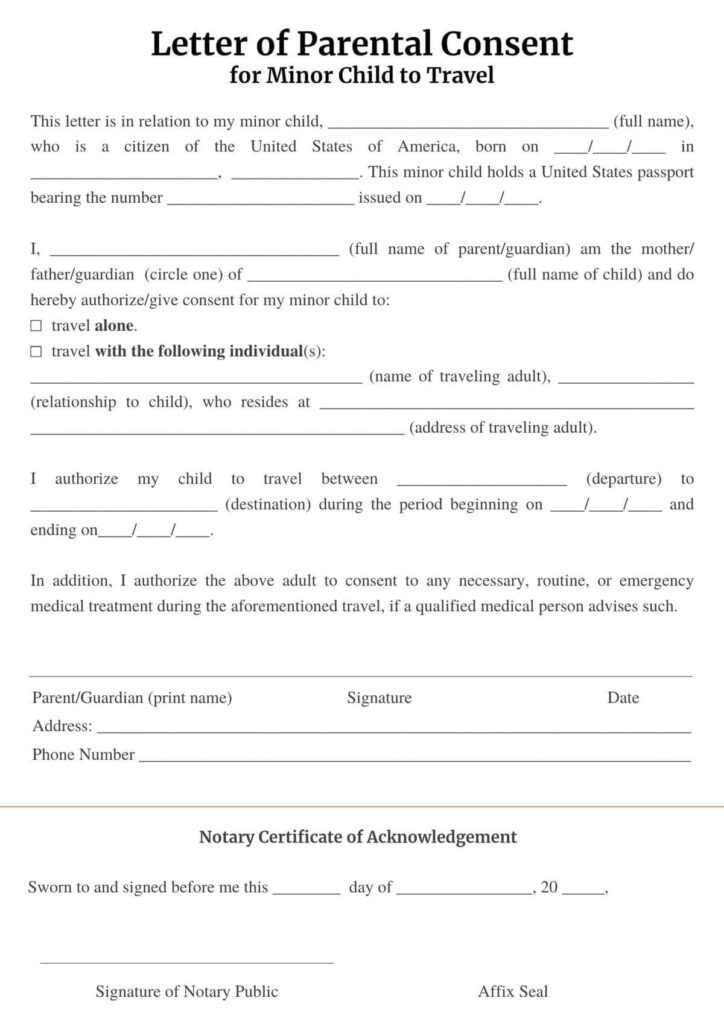
There is no official format or template for a consent letter. Different countries and airlines may ask for different details. The letter should typically include the following:
- The full name, address, and contact details of the parent or guardian giving consent.
- The accompanying adult’s full name, passport number, and relationship to the minor.
- The travel dates, destination, flight details, and the address where the child will stay.
- A clear statement permitting the child to travel.
- The signature of the parent or guardian giving consent.
Some authorities may ask for more, such as a copy of the child’s birth certificate. Always confirm before you travel.
How to Write a Travel Consent Letter
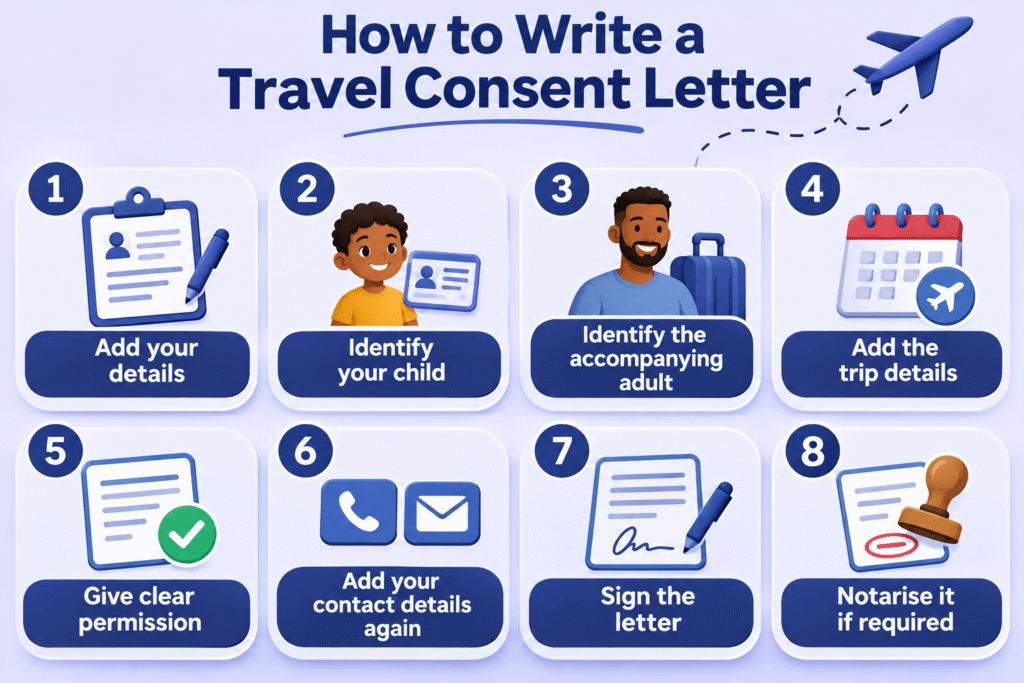
A travel consent letter should clearly explain who is giving permission, which child is travelling, who they are travelling with, and where they are going.
Step 1: Add your details
Start with your full legal name as it appears on your identification document. Include your residential address, phone number, and email address. Also, state whether you are the child’s mother, father, or legal guardian. If both parents are required to give consent, include the details of both parents.
Step 2: Identify your child
Write your child’s full name exactly as it appears on their passport or birth certificate. Include their date of birth and passport number if required. Check the spelling carefully; the details in the letter should match the child’s travel documents to avoid questions during travel.
Step 3: Identify the accompanying adult
If your child is travelling with another adult, provide that person’s full name, relationship to the child, and contact details. You may also include their passport number if requested. If the child is travelling alone, state this instead and check the airline’s unaccompanied minor requirements.
Step 4: Add the trip details
Explain where your child is travelling, including the destination country and city, if known. Include the planned departure and return dates and the reason for the trip, such as a holiday, school excursion, or family visit. If the child will visit multiple countries, mention them. Make sure the dates agree with the travel itinerary.
Step 5: Give clear permission
This is the most important part of your letter. Write a direct statement confirming that you authorise your child to travel. For example: “I give my consent for my daughter, [Child’s Full Name], to travel from Nigeria to the United Kingdom with her aunt, [Adult’s Full Name], from [Departure Date] to [Return Date].”
And I advise that you avoid vague statements like “I am aware of the trip,” but always make sure the letter shows that you have given permission.
Step 6: Add your contact details again
At the end of the letter, provide a phone number and email address where you can be reached during the trip. Use an active number, preferably one that can receive international calls or messages.
Step 7: Sign the letter
Sign and date the letter after reviewing all the information. Your signature confirms that you are the parent or legal guardian giving permission. If consent from both parents is required, both should sign. If only one parent has legal custody or authority to consent, supporting documents may be necessary.
Step 8: Notarise it if required
Some countries, embassies, immigration authorities, or airlines may require a notarised travel consent letter.
If notarization is required, take the letter and your identification documents to a qualified notary public. Do not assume that every destination requires notarization. Before travelling, confirm the requirements with the destination country’s immigration authority, relevant embassy or consulate, and airline.
Get your travel consent letter
Travel Consent Letter Sample
This is an example of a travel consent letter.
Date:
To Whom It May Concern,
I, Adams Sam, of 15 Independence Avenue, Abuja, Nigeria, telephone number +234 ————-, and email address adams@email.com, am the father and legal parent of:
Child’s Full Name: Chisom Sam
Date of Birth: 14 March 2015
Passport Number: B12345678
I hereby give my consent for my daughter, Chisom Sam, to travel from Nigeria to the United Kingdom with her mother, Dora Sam, from 15 November 2026 to 30 November 2026.
Accompanying Adult: Dora Sam
Relationship to Child: Mother
Address: 15 Independence Avenue, Abuja, Nigeria
Telephone: =234 802 345 6799
Email:dora@email.com
The purpose of the trip is to visit family in London. I give my full permission for Chisom Sam to travel with her mother for the duration of this trip and to return to Nigeria on or before 30 November 2026.
I can be contacted using the telephone number or email address provided above if confirmation of my consent is required.
Parent/Guardian Giving Consent:
Full Name:
Signature:
Date:
Witness/Notary, if required:
Full Name:
Signature/Stamp:
Date:
Does a Travel Consent Letter Need to Be Notarised?
Sometimes, but not always. Whether a travel consent letter needs to be notarised depends on the destination country, the child’s circumstances, and sometimes the airline or other authority involved.
For example, the US Department of State explains that some countries require a signed and notarised consent letter when a child travels internationally with only one parent or when the child travels alone or with someone who is not a parent or legal guardian. Source: Travel state gov
Frequently Asked Questions
Yes, A consent letter may be used as part of a minor’s visa application if the embassy or visa authority asks for proof of parental consent.
Often, yes. If the children are from the same family and travelling together, one letter may cover all of them.
If the other parent cannot be reached, you may need a court order allowing the trip or proof of custody.
Conclusion
A travel consent letter is a simple way to show that you, the parent or legal guardian, have permitted your child to travel without you. It is especially useful when your child is travelling alone, with one parent or with another adult. A good letter names the child, the accompanying adult, and details of the trip.
Do not assume that the same consent letter format will work everywhere. Requirements vary between countries and airlines. If you need help preparing your documents for your journey, contact a document agency to help you handle it.
Get your travel consent letter